Herring gulls
Where the Crawdads SingHerring gulls are among Kya Clark’s most persistent companions in the marsh: she feeds them, recognizes them as individuals, and returns to them when human attachment has brought hurt. They are also part of her family’s history. A reunion with Jodie Clark reveals that Kya’s childhood bond with the birds began with a sister, not in solitude, and the recurring gull called Big Red carries that connection forward across generations. Their feeding behavior, in turn, gives Kya a concrete way to consider how delicate parental care can be.
Presence and Recognition
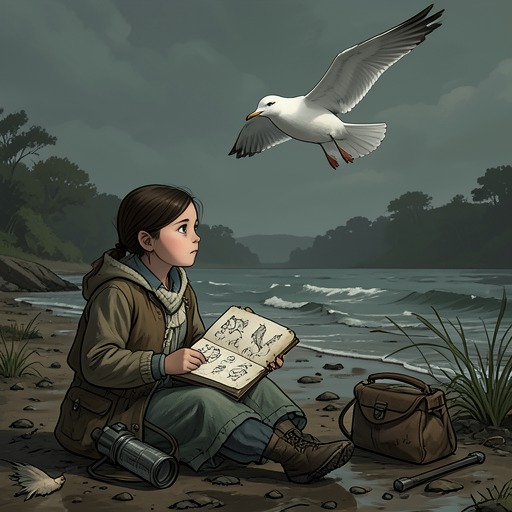
The gulls gather around Kya’s beach, where her familiar call brings them circling close. She feeds them cornbread, and one large male, Big Red, lands and walks across her feet. The scene makes her closeness to the birds tangible: they come within reach, while her relation to them rests on repeated attention rather than ownership or confinement.
Kya’s knowledge of the gulls is specific. Big Red is not simply a label for a red-marked bird; she recognizes the bird present now as one in a succession. When Jodie tells her that one of their sisters used to feed the gulls and named one Big Red, Kya explains that she has known several generations of birds by that name. The current Big Red, she points out, is the one on the left. A name persists even as the individual changes, joining Kya’s present routine to a past she cannot fully recall.
A Bond Rekindled Through Feeding
The gulls’ presence matters most clearly during Kya’s grief over Tate Walker’s absence. After waiting for him and losing hope that he will come, she watches fireflies and then walks back toward the shack. Days later, she has slept unusually late and has been roused by a Cooper’s hawk at the screen door. She makes hot water and grits, carries the food to the beach, and scatters it for the gulls. They whirl and dive around her; as their feathers brush her arms and thighs, she smiles even while tears run down her face. Feeding them does not undo her sorrow, but it gives her a physical, reciprocal contact with living creatures at a moment when she is alone with it.
That routine falters after July 4. For a month Kya stays at home and does not go into the marsh or to Jumpin for supplies. She lives on dried fish, mussels, oysters, grits, and greens. When the shelves are finally empty, she goes to replenish them but does not chat as usual; she leaves Jumpin standing and watching her. Her withdrawal makes a contrast with the beach scenes: she has stopped seeking human company, while the gulls remain part of a familiar pattern of care. The birds are not a cure for isolation, but feeding them remains an action she can still choose.
Chase Andrews Sees the Gulls—and Kya
When Kya takes Chase Andrews to the beach, she cuts pieces from leftover cornbread for the gulls and walks ahead of him toward the sand and sea. Her soft call brings the birds around her shoulders. Big Red lands and walks across her feet, repeating the close approach that makes the bird a presence in her daily life rather than background scenery.
Chase watches from a little distance as Kya disappears among the circling birds. He is intrigued by her self-reliance and beauty, and asks to return the next day, promising that he only wants to be near her. For Kya, his request is the first hope she has felt since Tate left. The scene therefore connects the gulls to a turning point in her human relationships: Chase’s interest begins as he watches her in a world of her own, engaged in a practice already shaped by trust and familiarity with the birds.
That connection does not make the gulls mere instruments of Chase’s attraction. Their feeding continues to belong to Kya’s routine, and the birds’ movement and closeness remain part of what he observes rather than an act performed for him. Later, when she discovers an article spread open on the table and flees into the woods as Chase arrives, she waits until his boat has gone before returning to the beach. There she gets food for the gulls, throws pieces of French bread into the air, and swears into the strong wind. The familiar act persists, but the scene carries anger and distress instead of the earlier promise of courtship.
Family Memory and the Red Spot
Jodie’s account revises Kya’s understanding of where her bond with the gulls came from. Kya had thought she began feeding them after everyone else left. Jodie remembers otherwise: their sister fed them whenever she could get away with it, gave them names, and called one Big Red because of the red mark on its bill. Kya tries to connect with the sister through the story, but can see only the face in a painting. Even so, the recollection gives her a family fragment she had not possessed before, and the living Big Red on the beach makes that fragment present without restoring a complete memory.
The mark has a function beyond its appearance. Kya knows that gull chicks peck the red spot on a parent’s bill; only when they do so does the parent release captured food for them. If the spot is obscured and the chicks do not tap it, the parent will not feed them, and they will die. The detail makes feeding a matter of communication as well as provision: the chick must respond to a signal for care to occur. Kya concludes that even in nature parenthood rests on a thinner line than people may assume. The behavior does not erase the difference between animal life and human responsibility, but it gives her an exact natural example through which to think about how vulnerable a parent-child bond can be.
Natural Knowledge and the Meaning of Care
Elsewhere, Kya watches female fireflies alter their signals to attract males and then eat one of them, and she concludes that judgment has no place in that biological process. Her reading of animal behavior supplies a framework for understanding survival without making it a simple measure of human right and wrong. The gulls’ feeding pattern presents a different aspect of the same natural world: not deception or predation, but the exchange between a chick’s signal and a parent’s response.
That distinction gives the gulls’ appearances a quiet complexity. They accompany Kya through isolation, connect her present self to a sister’s remembered care, and bring her into Chase’s attention; their feeding behavior also sharpens her reflections on parenthood. The repeated name Big Red holds both continuity and change: Kya keeps recognizing the gulls, though the individual bird changes, just as family stories can preserve a bond without restoring everything that has been lost.